
A more generous world is possible.
Every year on September 15th, people across the world hand out their own money to complete strangers, in person or online, asking recipients to pass half on to someone else. It’s a simple experiment in generosity that invites us to question our relationship to money. Are you daring enough to give it a try?
Three ways to take part
Ready to spark generosity and inspire conversations about the meaning of money? Here are three easy ways to get involved:
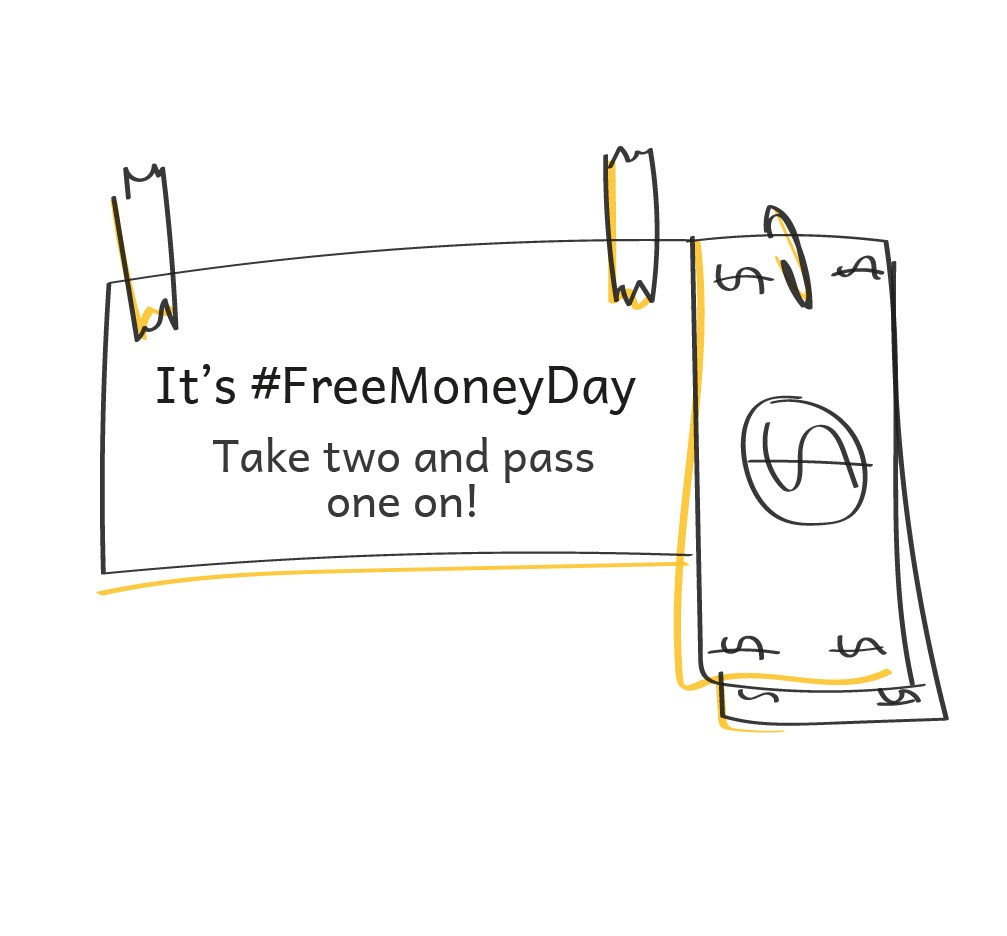
1. Leave money as a surprise
Spark the spirit of generosity by hiding two banknotes with a message to pass one on. Write a note, find a location, and leave money for someone to find.
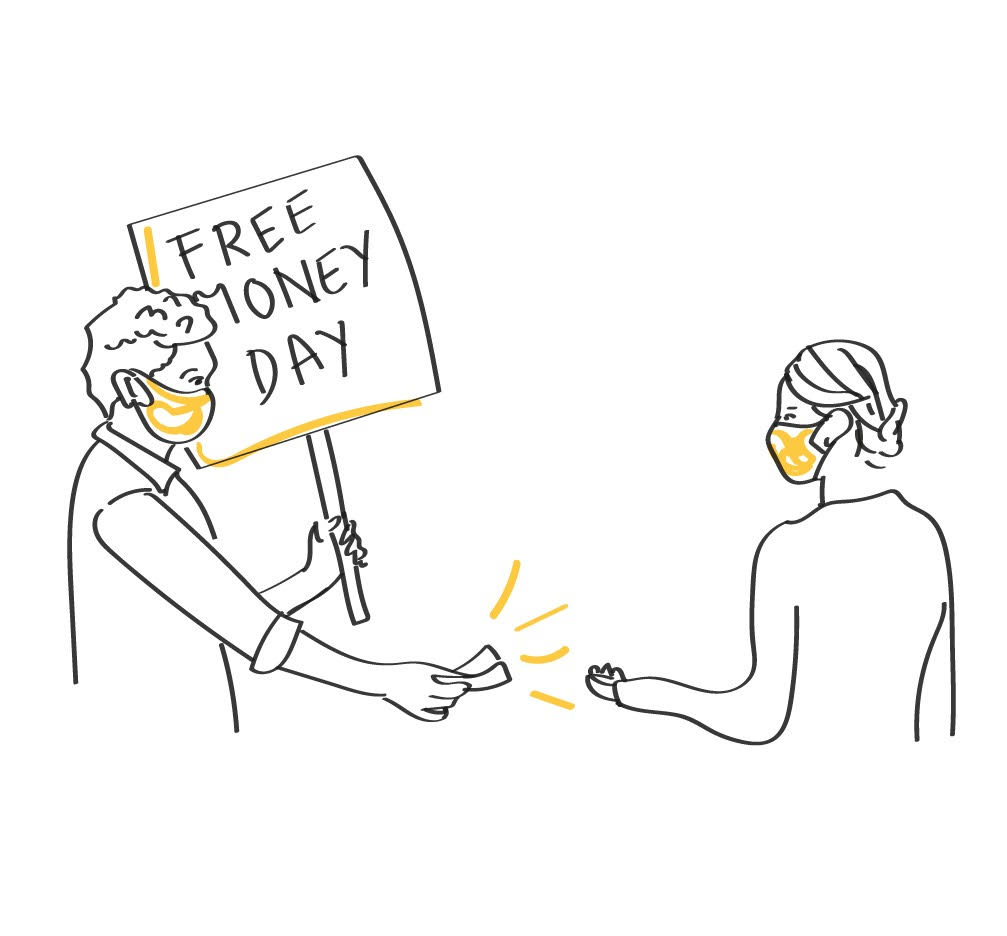
2. Share money in person
Galvanize and inspire your community by setting up an event in your local area. Find a public place and give out two coins or notes at a time.
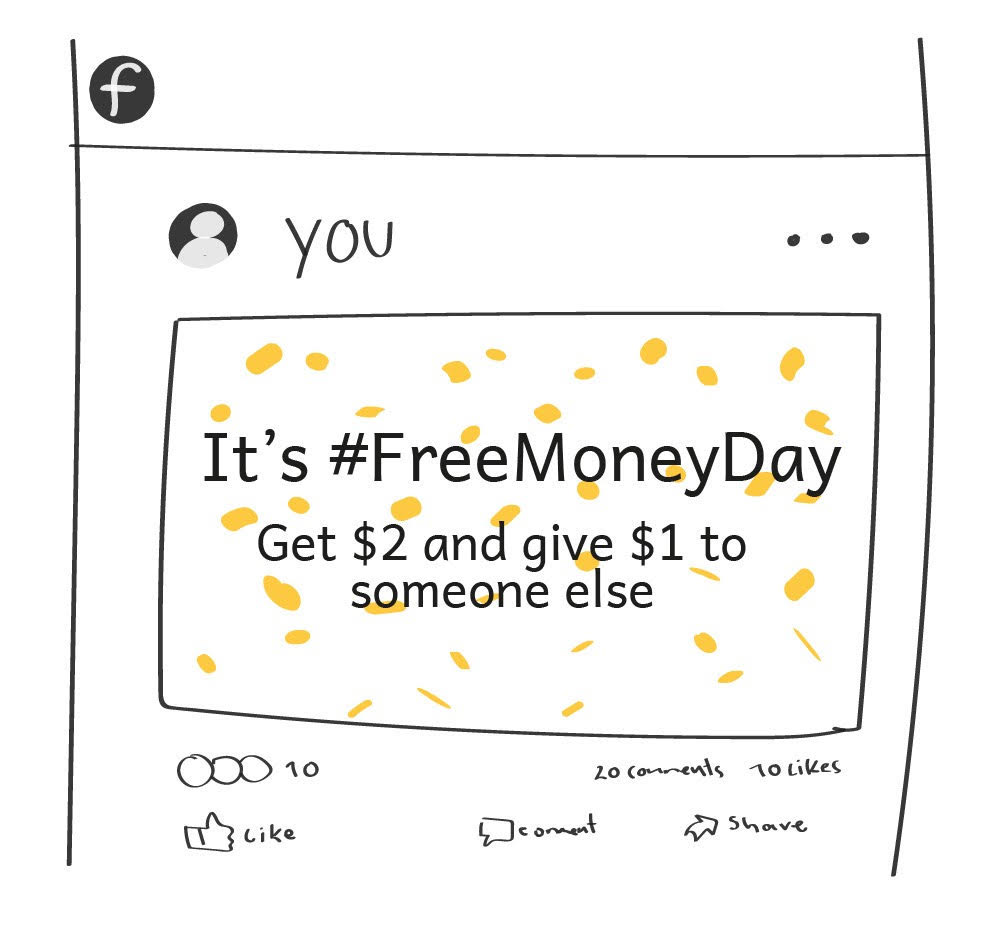
3. Give money digitally
Connect with people across the world by giving money digitally or hosting a virtual event. Choose recipients and send money through a digital payment platform.
Why Free Money Day?
On September 15, 2008, Lehman Brothers, one of the world’s largest investment banks, filed for bankruptcy. This incident, which has become symbolic of the Global Financial Crisis, triggered a series of events which contributed to global financial mayhem, the repercussions of which are still being felt today.
Motivation for the day
Money, as a medium for exchange, helps keep many economies running. A certain level of income is vital for people within such systems to be able to meet their basic needs. However, research consistently suggests that, beyond a certain point, having more money does not increase an individual’s wellbeing. We also know that happiness is highly related to how socially connected we are, that giving money away can contribute to individual happiness, and that opportunities to have informal conversations with people in our communities are also significant for wellbeing.
Our obsession with making more money as individuals is mirrored by our societal addiction to unending economic growth, despite the fact that neither of these, at the end of the day, makes many of us any happier. The money systems in which we are currently enmeshed are fundamentally unstable. They create bubbles and a destructive boom-bust cycle, which result in loss of jobs, homes, health, and even lives.
Perhaps it’s time for ‘signal interruptions’: things that get us questioning what we believe to be true and what we truly value. Free Money Day is one way to playfully interrupt the ‘more money / more economic growth’ signal. It’s a fun and exciting means to have the courageous conversations we need around things like ‘how much money is enough?’, ‘do we always need to grow our economies?’, ‘how well is economic competitiveness really serving us?’ and ‘does sharing make more common sense?’
Frequently asked questions
About the event
Is this an ongoing, annual event?
Yes. Free Money Day occurs around the world every year on 15th September (the anniversary of the Lehman Brothers collapse that sparked the 2008 financial crisis).
How much money can I give away?
This is totally up to you. Anything is great, as the money itself is simply intended to serve as a catalyst for conversation.
Where do I get the money to hand out?
As a participant you would be giving away your own money! As a social experiment this is about what interactions you have, what responses you have, and how it makes you and others feel.
What if I want to participate but don’t want to hand out money?
You can still participate! Many people have participated in the spirit of Free Money Day by handing out free hugs, movie rentals, or gifting conversations to complete strangers. Creativity is encouraged!
How long does this take?
It could be as quick as two minutes or as long as half a day. It’s entirely up to you.
What if no one will take my money?
It’s possible. Others have run somewhat similar events in Australia and Ireland where this happened. If this is your experience, don’t stress. Even if people don’t take your money, chances are you’ve got them thinking and that’s a wonderful outcome in itself.
I’m actually pretty nervous. What can I do?
In situations like this, taking a deep breath is good too. Know you are not alone and remember this is a social experiment. Expect a range of reactions!
Is this legal?
We don’t know of any circumstances in which a non-violent, public distribution of money is illegal. However, we would recommend you check with your country’s laws if you’re unsure.
What if I’m approached by the media?
Wonderful! A chance to build interest in the day and associated issues. Please make sure you state clearly to the reporter, writer or host that you are speaking in a private capacity, not on behalf of the Free Money Day event or organising group.
About the philosophy
How does giving away money encourage less growth?
Free Money Day encourages us to think about what money means, how we attach value to it, and where it comes from. It invites us to experience the feeling of giving money away, which is counter to all the social signals we receive to accumulate ‘more’, and to appreciate the non-monetary things we give and receive, such as a smile or another meaningful interaction with someone.
What are the benefits of more sharing economies?
More sharing economies open up the possibility of alternative approaches to wellbeing that go beyond the simple driver of more. With resource scarcities and financial upheaval impacting on so many of us, it makes sense to become more resilient by sharing, since it can be sustained over the long term, whereas growth cannot. Sharing also means we need to buy less, which has great environmental benefits: we use fewer resources and less energy, and create fewer greenhouse gas emissions.
Are you saying money is not important?
In the societies in which many of us now live, money does have roles to play, for everyone. Access to money is critical for many of us to meet our needs for shelter, food, healthcare and transport. We do not intend to downplay this reality. But the pursuit of ever more money as an end in itself can be a trap that robs us in other areas of our lives. We want to question how it is that so many of us end up working too many hours, in too much debt, and how this adversely affects our lives. By giving money away, we ‘interrupt the signal’ of the money program we subconsciously run: always believing that we never have enough, and that we are afraid of running out of it. In the process, might we open up exciting futures beyond the pursuit of more?
About the organizers
Who are you?
A group of people who believe that there is more to life than the pursuit of money and endless economic growth.
About Free Money Day
Free Money Day is a global invitation for people to explore, in a liberating and fun way, what it might be like if our relationship to money was a little different. Each September 15th, worldwide, people hand out their own money to complete strangers (virtually or in-person), two coins or notes at a time, asking the recipients to pass one of these coins or notes on to someone else. It’s an opportunity to start conversations about money, sharing, and anything else that might come up.
Free Money Day has been running annually since 2011 and is an initiative of the Post Growth Institute (PGI). The PGI is an international, not-for-profit organization leading the shift to a world where people, companies and nature thrive together within ecological limits. We work collaboratively to develop ideas, programs, events and alliances that promote the equitable circulation of money, power and resources in our local communities and global economy.